Showing posts with label English. Show all posts

30 Apr 2018

The Single Malt Inc Or From Zagreb To Glasgow Without Touching The Motorway

It is a type of whisky at the point of reaching full maturity. It matures in bourbon casks for 12 years, and for the last three years it is kept in sherry casks to achieve an elegant balance between the sweetness of sherry and the fruity and smoky distillery character with a subtle hint of tropical fruit which will bring satisfaction to people who love the traditional Bowmore taste.  The Bourbon casks will give us a subtle hint of vanilla.
Each person in this world keeps a secret. Some of them are big, some are small. Even families have secrets. Xenophobia is, for example, a secret guarded by entire nations. Leaders of these nations, naturally, won't admit that they are afraid of foreigners. Instead, they will disguise it as a political policy of some sort. Then those, who are afraid, are not as scared, thus feeling better.

As much as secrets imply a certain dishonesty, even a type of calculation, they are here to keep you safe from danger. Just as the American opossum, the real walking dead, which, when it feels a predator is near, lies on its back and plays dead to keep itself safe.
This blog has a secret as well. And not just one! That is why the answer to the question: “What is a fifteen-year-old Bowmore doing under the Scottish stainless-steel sky on a deserted road?” might come later, if ever.

Not a millimeter of highway!

I left quickly, actually, the moment the opportunity arose. I felt restless for days before hitting the road. I love this state of mind: restlessness before a trip and the restlessness of a traveler.

I am probably an ordinary consumer, not much different from someone who will spend their extra cash to build an elegant tomb or a pyramid perhaps, instead of just spending it on traveling.

Everybody experiences this world in their own way. Traveling is just one of them, in no way more important than any other.


I am searching for beauty. Naturally, it is not necessary to travel 2,500 km by motorcycle to encounter it. It is always here, sometimes even living within us, or so to speak, living around the corner.

When you slide off Bologna Boulevard (the street in the outskirts of Zagreb) and start meandering through villages up to the Slovenian border and then through Slovenia and Austria, there is so much beauty and it fills your soul with such delight and while you are feeling it, nothing else is that important.

If a traveler opens their eyes a bit wider, they will find beauty even on a highway, among the nervous hustle and bustle of the masses. Each act of kindness that takes place there will add to that feeling. Yet, your eyes must really be wide open to be able to see the charm of the highway even when somebody is overtaking you and the headlights of a souped-up beast of a muscle car keep aiming at your stern until you surrender and let them pass.

That is why I decided, and because I had a few extra days for the journey, to arrive in Glasgow, Scotland by avoiding contact not only with highways, but also with all other multi-lane roads until I reached my destination. To go through with that decision, once you have set a course, it is enough to press a few buttons on your GPS and change the settings to exclude highways and multi-lane roads, and leave the option for, e.g. off-road ride.

That way you will pass through numerous ski destinations in Italy such as Innichen, Cortina and Brunico as well as small towns in the Bavarian Alps, each and every one of them pristine, like a carefully trimmed and manicured moustache.

Then you have Colmar in France and mass grave sites from World War I along the River Somme with occasional reminders of its horrific history.

Before boarding the ferry to England, the Burghers of Calais will escort you with their sad symbolism.


Google Maps’ ETA proved to be incorrect. With some effort you can reach Calais in 22 hours by avoiding highways, no matter how you schedule it: 2 days of an 11-hour-long ride or however long you decide.

The beauty of simplicity in such a journey is irresistible. You don’t worry about anything; you always wear the same clothes, just like astronauts don’t worry about which space suit they will wear that day, you jump into your own and you are at ease; you don’t even worry what you will be doing that day; you simply travel from dawn till dusk and when there is still some visibility left, preferably, you find a place to sleep.

On the English part of the Isle the wheels started rolling more carefully than they did on continental Europe.  Not out of awe because they strode on the ground which Milton, Shakespeare and G.B. Shaw trod, but because the same GPS option of avoiding highways did not have the same effect from the south of England in Kent up to the Midlands.

England is densely populated. In its automobile culture there is a constant need to alleviate the roads of heavy traffic. They do this by adding one or even two lanes to existing small country roads, even though we are not talking about a highway. All those roads connect cities the same way they do in Europe - each of them takes you straight to the town center, but, due to terribly congested traffic, taking these roads is not as nearly as romantic as on the continent. It takes a bit more planning to drive through this stunning English province.

Even Saint Augustine who was sent to what used to be called Anglia by Pope Gregory I  to baptize the people strode through Kent. Before he shone forth with his theology, he wrote geeky letters to the Pope inquiring, among other things, if a woman could go to church if she had had sexual relations the night before. Gregory I responded wisely by saying that there was no obstacle to allow women to go to church, under the condition they wash beforehand. Bertrand Russell made no further mention of that correspondence, although a few more questions could be made regarding this particular topic.

The road took me through the small town of Reigate in Surrey where I was, in a unique way, by a Winston Churchill monument, reminded of our past. Will the followers of the Croatian iconoclasm become active again and take matters into their own hands?

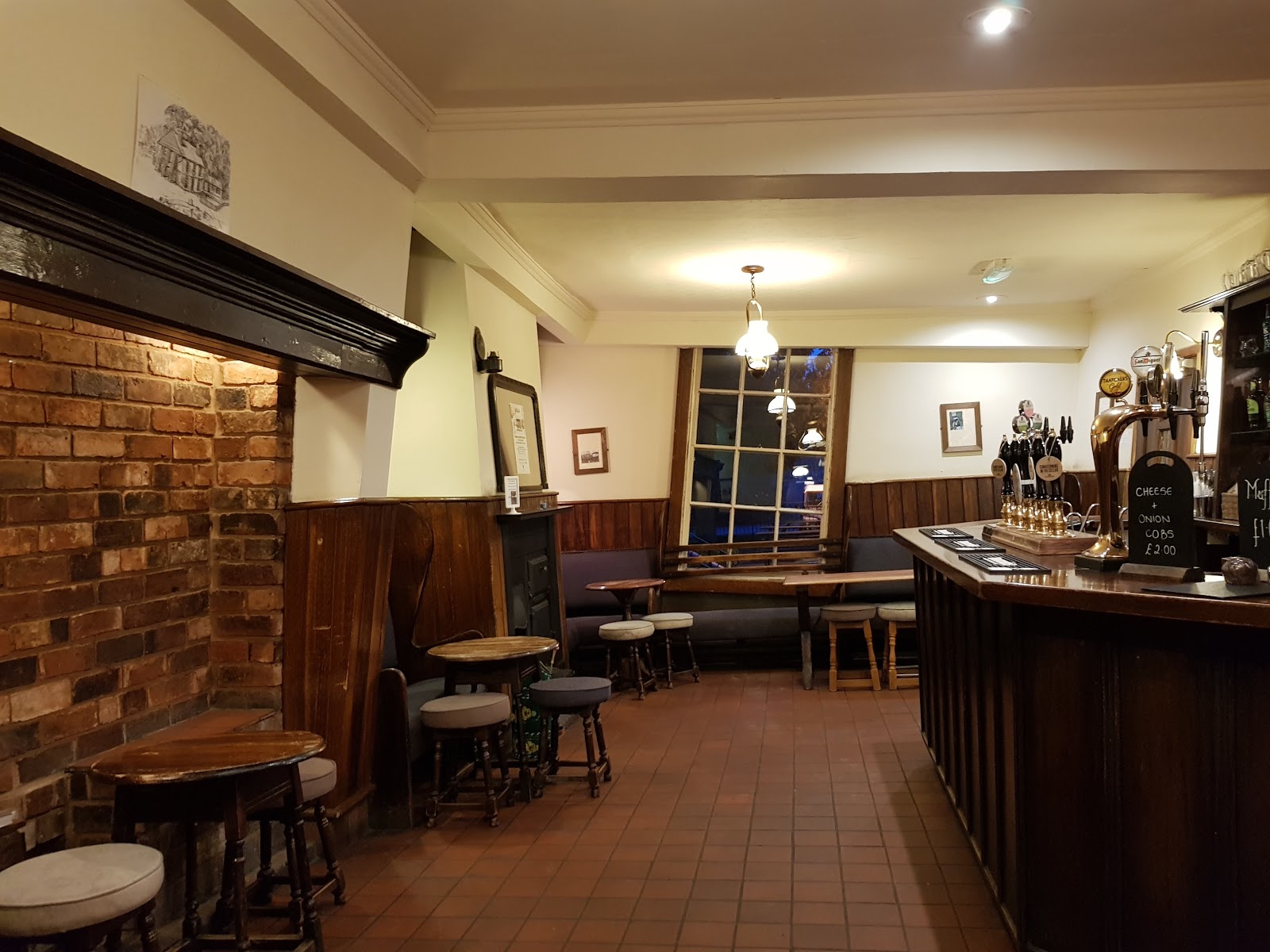
Before going to sleep at a 16th century pub in Stourbridge, I had a pint of ale in a lopsided inn.
While contemplating how to explain the questions of evil and sin in this world and while simultaneously avoiding compromising God's omnipotence, omniscience and his infinite benevolence, Gottfried Wilhelm Leibniz concluded that in this world evil is a divine necessity, and if it did not exist, we would not be aware of the true concept of good. That is why I accepted the freezing wind and rain which started to pelt me as I was leaving the South of England behind. And instead of floating through the countryside in a superior and indifferent manner, like only a camel would, without moving its head or body, bending its neck in a hypnotizing rhythm; I contracted my head between my shoulders, shrunk like a pork crackling and shivered as my spirit was broken until I was pulled upright by the warmth of my York refuge. In that sense Leibniz is right that this is the best of all possible worlds, because I would not know how to appreciate the warmth and the hospitality of the York harbor without the preceding suffering.

I dedicate this blog to a good man, father Ivan Cebulski, a missionary, who crossed over to the other side earlier this year. He was incredibly humorous. We had interesting conversations during which he showed me that it was possible to be cradled in an infinitely patient and consistent system while simultaneously keeping freedom of thought and healthy skepticism.
I keep traveling further north. The BBC weather report saw me off with a discouraging weather forecast of an uncommonly cold spring with temperatures falling between 2 to 5 degrees for the next few days in the north accompanied by strong eastern winds and rain supercharged by the even colder North Sea. I do not give up on the plan to avoid the M1 motorway or equally congested multilane A1 road. Instead I try to cross over the hilly plateaus of North Pennines and the Yorkshire Dales National Park and choose the most scenic route. I am not very successful at it. The wind is literally trying to blow me off the road and blow the rain under the helmet. My nose is constantly runny, and there is no way for me to wipe it, unless I stopped, which is something I do not want to do. I occasionally sneeze, which makes the mess in my helmet, where my eyes and mouth also reside, very slimy. 6 hours later I throw in the towel and press the “Quickest route” button which will take me to Glasgow in an hour.

I spent ages in a hot shower trying to thaw my frozen body thinking whether Leibniz’s conclusion was incorrect. Isn’t the good in this world, including this wonderful shower, here only to emphasize the evil, sin and the ice cold winds that were blowing my head off, while we are under the control of an evil demiurge and that is why this is one of the worst possible worlds. In that Manichaeistic mood, filled with doubt and my head held low I walked to a pub for a pint of ale. I had a few of them and, interestingly, Leibniz’s logic revealed itself to me in all its iron-clad consistency. I chatted with the barman cheerfully feeling happy and sporting a smile on my face.

This interesting, deeply philosophical effect of beer made it self-explanatory why someone would convert a church into a pub which I saw on my way home. Was the decision about the conversion made by priests under the beneficial philosophical influence of beer during a theological discussion in a pub or church or after a seminar in a pub, it is unknown, but here it is nonetheless:

The next day, thanks to my host and friend, brought an entire bag full of surprises. Early in the morning we take an Uber to the airport. From across town a bike rental team is rushing to the same place and carrying two bicycles. We meet at check-in. Many things could have gone wrong, some of them even tried to, but still the bikes flew with us and landed on the southern Scottish island of Islay.
And that is how a new study tour started. We tried to find out how barley, peat and water in the hands of skillful island craftsmen are merged together into a formula which will, in controlled quantities, help answer many ontological questions.
Lagavulin, Ardberg, Bowmore, Laphoraig distilleries – they are all here. And we visited them in that order.


The effect of enlightenment, after a few tastings, was evident. I started to notice things whose existence I hadn’t even acknowledged before.

Friendship:

Loneliness:
Arrival:

Due to the eastern wind which grew stronger at night the chances of returning to Glasgow by plane had drastically fallen. Since we, the day before, due to strong wind and low clouds, had had a couple of unsuccessful attempts at landing and the pilot had to, as it was his fourth attempt at landing, I think, grit his teeth and land at full throttle. The wings did not fall off, our hearts just started beating somewhat faster. That is why we decided to go to Glasgow by bicycles. Cool! You arrive by plane and return by bicycle.
We left early. We were supposed to catch a few ferries and pedal across the islands of Islay and Arran and cross a few mountains. Well, the bicycles were electric, but they assist you only if you press the pedals. The faster you push, the quicker you go, so covering around 150 km is not that big of a challenge as Google Maps made us believe. What takes 9 to 10 hours on a regular bike, you will cover in 6 to 7 on an electric one. Fantastic! Naturally, I contemplated the subject of good and evil in this world again because of the rain that constantly kept pouring although I felt like I had learned the truth earlier in the journey. Is reality really an illusion caused by the lack of alcohol, which we had been warned about for years by the graffiti on the façade of a building in Jurisiceva Street (a street in the centre of Zagreb).

Exhausted, but bathed and fed, I peacefully awaited the following day and the return to Zagreb by taking the quickest route on the highway. You shift into the “heavenly gear”, as my good deceased friend used to call it, and let the BMW devour the kilometers. All 2,500 of them! It should take two days if everything goes as planned.


And now, what has a 15-year-old Bowmore in and idyllic countryside got to do with a ten-kilometer traffic jam on a highway in Belgium because of a colossal traffic accident?

I got on the highway, after disembarking the ship, with everything I think represents my character: strong individualism, independence, intuitiveness and self-consciousness. Yes, that’s me! Because of this, people’s astonishment on the eve of the journey when they were asking: “What? Why make the entire journey just to spend 48 hours in Glasgow?” only confirms the hypothesis of what I am like: authentic and true to myself! The Bowmore photo was taken with the ease of a free individual. I can do whatever I want!

About fifty kilometers from Zeebrugge towards the southeast, on the way home, there was a massive traffic jam. That is nothing to motorcyclists. You split lanes or use the highway emergency lane, obviously you ride more slowly, but you keep going. I had been splitting lanes through the long line of static vehicles. It was obvious that the traffic had stopped hours ago because some people had left their vehicles and were sitting on the asphalt, lying on their hoods, and truck drivers were sitting on their folding chairs in the shades of their trucks. I reached the front of the line of motionless vehicles. The highway was closed off with police tape and behind it there was a scene of a terrible collision between two semi-trailers. Sand, concrete, cases, everything was scattered on the highway. Cranes, firefighters, the police! You could immediately tell that the delay would last for many more hours. The highway was fenced off, so it was impossible to even ride on the side of the road. I found the nearest highway exit on the map which was approximately 7 kilometers away in the opposite direction. “What’s that got to do with anything, there is no traffic anyway, people are sitting on the road, I will manage to squeeze through somehow,” I thought to myself. I jumped on my bike again, I started it up and slowly turned in the opposite direction.

During that maneuver, one of the bikers I had exchanged a few words with a moment earlier, approached me. Belgian bikers also managed to pull through to the front of the line of vehicles.

He was asking me where I was heading to. I explained it to him that I was going back to the closest exit. “But that is in the opposite direction,” he said. “It is an extremely risky move,” he said clearly upset. “There is no traffic,” I tried to calm him down. “People are sitting on the asphalt. Nothing can go wrong.” “But that’s 7 kilometers,” the biker would not give up. A buddy of his who joined him just kept shaking his head. “Bat z polis mej cum, zej hev sajrens end evrising, zej vil get ju, its rong dajreksn,” finally said the guy who was shaking his head. We were approached by another guy and now all of them, I presumed, were discussing me and my plan in Flemish and naturally were shaking their heads and glancing at me from time to time. The third guy said: “You know, it’s your call. You know what you are doing.”

At that point, I slowly turned the key and shut off the engine trying to delay my self-confidence from draining away as much as possible. I sat on the fence, as weak as a fly, and on the brink of tears started to look at the tips of my boots. A conformist wretch. Three hours later nothing had changed. I was sitting on the fence, occasionally chatting with the Belgians.

A policeman on a motorbike approached us from the direction of the crash. Going in the opposite direction, of course. Someone attentively lifted the police tape, so he could go under it. He had to pass by me.  With the remainder of my usually ever-present initiative, I got up and stood in front of the policeman. He stopped his motorbike. “Please, I am also a biker, would it be possible for me to drive between the line behind you until the exit?” I asked. “Of course, let’s go,” said the police officer. I whistled to the other bikers and all of us, guided by the police, accompanied with flashing lights and sirens, headed towards the exit.

Solomon Asch who was a pioneer in social psychology claimed that group pressure is in most cases stronger than the will of an individual. In the conflict with free will, conformism generally wins. Naturally, it does not always happen, but it happens more rarely that a charismatic individual dominates over a group of people. In Asch’s experiment, a few participants pretend they know nothing of the test and that they do not know each other. They enter an elevator in a multistory building after a man who knows nothing about the experiment. This man, after he pressed his floor button, normally faces the exit. However, one floor down one or two new passengers enter the elevator. They, after pressing their floor button, face backwards, where there is no door. On the next floor down a new passenger gets into the elevator. He also faces the side where there is no exit. After a few more participants who know that they have to face the other, illogical way get on the elevator, the conformist broken down by group pressure will turn around and face backwards, following the example of others.

8 Oct 2017

The Black sea loop and how we failed

This is how the trip was supposed to look like geographically. For many different reasons the route started to develop as follows:


When Paul the Apostle, probably after strolling through the Acropolis just like any other tourist, climbed the neighbouring Areopagus hill to explain to the Athenians the errors of polytheism and to bring them closer to faith in the One and Only God, the Almighty Father, the temples on the Acropolis were still standing in their full glory, and the city at the foot of both the hills basked in the deep shadow of the monumental Parthenon and in the classical harmony that spread down from the heights.


Had Paul at that time, after clambering up Areopagus, seen stretching before him this scene of endless concrete structures, without one single green twig to provide some coolness from the burning summer heat and bring some humanity into the life of the Athenians, perhaps his speech would have turned to subjects of designing the public environment and town planning. Because, does that greyish relief that reaches as far as the eye can see hold anything of beauty; is there anything beautiful in the plucked monuments on the neighbouring hill? Who would want to live there, unless forced by dire necessity?

Edi Rama:


Edi Rama is a painter. What is more, he was a secondary-school art teacher when he became Mayor of Tirana in 2000. This was only ten years after the fall of the paranoid communist regime, and aggressive post-communist consumerism was in full swing in Albania. Today Tirana, especially its suburbs, looks just like someone who had never been to the city might imagine it. Bad news has always travelled faster and reached further. Morning in the courtyard of a hyper-modern hotel in the city centre still begins at five in the morning with the screeching of a cock.


According to Rama, in 2000 Tirana was a city populated by people who had to live there. There was not one single inhabitant of Tirana who wanted to live there because they had chosen to. So the artist Rama decided to change his city making use of what he knew best: colours! He began to paint the faceless grey facades, which the communist regime had kept that way on purpose to discourage any diversity or individuality. Speaking for TED, he gave a fantastic talk on the subject. 


In a sea of mediocrity, corruption, rejection of principles or, even worse, in a world where principles no longer exist, a man with an idea and a bucket of paint can bring hope to people who lost it long ago, and build up human happiness. In a world of this kind, we think, as we wander through the remains of the classical Agora and the probable site of the cell in which he had drunk his poison, Socrates’s death loses its futility, and the dreams of Plato, his pupil, that the state should be governed by philosophers because they think about human happiness, while all politicians care about is their own gain, still stand a chance. Today Edi Rama is Prime Minister of Albania. His eleven years at the head of Tirana will long be remembered!


The harmony of Antiquity has not been living in Athens for a long time. Today, on the graffiti-streaked facades, on streets and pavements that have barely been swept, through the lives of thousands of immigrants who endlessly roam the streets day and night seeking for any kind of work, or sit around in groups in front of small shops selling mobile phones and soap or in front of their miniature stands with tomatoes and peppers, and through hundreds of young, hyped-up and unemployed Greeks, there is a battle taking place between Order and Disorder.


Things do not stand well for the Order we are used to, that is as clear as day, just as it is clear that this flood of wretched people who have left behind their fields and towns in the East will breach our own shores, too. Has Order slowly, through the centuries that rushed past, been losing ground to its antonym? From Phidias’s temple of Beauty and Harmony to the graffiti of today – is Disorder the true state of man, and Order no more than a historical glitch?


Since Disorder has been winning battles for centuries, people are building well-protected fortresses around the artefacts of Order, which are for now keeping Disorder at bay outside their walls. The top picture shows the small but firm and unusually sexy little fort in Sv. Vid near Metković (south east Croatian town), which keeps remains from Narona, and the bottom picture shows the ultra-modern Museum of the Acropolis, both built as the guardians of Order say: In situ.

Outside these fortresses, on the city market, Order and Disorder do not clash. The world seen through the eyes of the market has not essentially changed since the time of Pericles.  


In memoriam:

I dedicate this blog to Professor Janko Paravić, literary translator and simultaneous interpreter and jazz lover, who left us suddenly this August. Although he was official interpreter for all the Croatian presidents and heard many conversations, including, of course, those held at delicate times, he never repeated one single word although many people, thirsty for scandal, besieged him with propositions. He was a gentleman in the true sense of the word! In this hot summer he enthusiastically helped with the translation of the Spanish blog. I am sorry that we did not spend more time together.


From Athens to the Black Sea and further on


The story above led to a spirited discussion about which is stronger, Order or Disorder, and is the Parthenon proof of order or disorder. Unfortunately, the participants sent their comments in emails, which makes their contributions private. I don’t know why everyone refrains from commenting on the blog itself. In short, one school thinks that the spreading of Disorder after the perfection and harmony of Antiquity is obvious. They say: “There is a theory in quantum physics (and quantum physics itself is no more than a theory, closer to philosophy that to physics) which says that the passage of time does not change things from chaos to a world of order, but the opposite – from a world of order to chaos. Evidence for this is the whole and broken drinking glass. Once it has been broken, it cannot be returned to its original state of order, which is also proof that time cannot run backwards. Although the passage of time is a relative concept because time curves together with space so that, as old Einstein would say, past, present and future are only an illusion."


Of course, when we consider the Acropolis and the pearls of classical architecture on the one hand, and on the other the quarrel emanating from the trashed facades in the form of mostly angry political messages, things seem to be clear and the decadence of Order into Disorder is obvious.  

However, should one not think about what the slaves would have to say in this discussion, and this is the view taken by the other school. In the golden age of Pericles every household in Athens had five or six slaves, a total of eighty thousand. Without them none of the monuments that we marvel at today would have been built. Consequently, it is not very likely that they would agree, in this discussion, with the theory that the time in which they were enslaved and in which they built the artefacts of antique harmony was a time of order. In saying this we have transformed slavery from an economic into a moral fact, which makes the graffiti somewhat less irritating. Or does it?  


Alexandria / Alexandroupoli 


Obviously, the small town was named Alexandria after the famous Macedonian who was born just several hundred kilometres away, in the village of Pella. The irresistible charm of long-distance motorcycle travel also lies in making only a rough plan of your route: you move east towards the Black Sea, and it will end as it does… Many people are not ready to accept this kind of uncertainty, thinking that planning details makes up the skeleton of a journey which prevents the programme from falling apart. Countless times this theory has shown itself to be completely wrong. And so today, although I was riding roughly northwards from Athens, and then eastwards, without any plans about where to spend the night because you never know how things will turn out, I ended up, now for the third time, in an elegant hotel in Alexandroupoli in which, it turned out, I was already regarded as an old guest cordially welcomed at the reception and given an immense discount without any negotiations. We had stayed here for the first time eight years ago, tired and dusty, on our return from Syria and Lebanon. The second time was on the way back from Iran; and each time we were happy that – barely able to move and exhausted from the long ride – we could sink into a bed as soft as a cloud. And so, neither is the World boundlessly immense nor are the possibilities endless: sooner or later one passes along the same route.

Dawn in Alexandroupoli:

Here we are, on the Black sea! Varna


A long, tiring and not especially picturesque ride along what were more or less tracks to Varna. We passed through Edirne in Turkey, the minarets of whose mosque are higher than those of Hagia Sophia in Istanbul, and which boasts several bridges.


In Bulgaria the small towns that sprouted in the endless wheat fields still look rather worn out; even when bathed in sunlight the bleak soviet greyness prevails.


And so, finally, we reached the Black Sea. Varna is the most important Bulgarian port and tourist centre. Only a road separates the enormous port from the endless sandy beach.


Throughout history the city changed masters like socks. After an unsuccessful Crusade against the Ottoman Turks in the fifteenth century it was taken by the Ottomans. Then came the Russians, then the English and the French, then the Russians again, who made a gift of it to Bulgaria in 1878. In WWII came the Germans. It was a city on the front lines and a key site in the Crimean War, the First Balkan War and in WWI. In 1944 it was conquered by the Russians again and given to the Bulgarians, together with the Russian system, which they kept up with the help of local sycophants right until the fall of the Berlin War.   
Varna has a vast pedestrian zone and broad squares. It seems that the Bulgarian style of town planning is not to skimp on the area given over to public use. Plovdiv, for example, has the largest pedestrian zone in the world. Why is this so? Is it the result of fifty years of minimalizing the importance of private ownership, allowing towns to generously cede their surfaces for public use? If this is so, then here, too, facts have been transformed from economic to moral. Because who could claim today that this result of the Soviet regime is not good for everyone. Except those, of course, who had property taken away from them! 


We ride along the shore of the Black Sea towards Constanta in Romania, down a road leading through the Golden Sands Resort not far from Varna. Hundreds of hotels are scattered along the yellow beach, merry-go-rounds, thousands of kiosks, kebabs, souvlaki, pizzas, but – there is no smoke. The season is over, only the brave have remained. When the season is in full swing, this does not seem to me like a place where you can rest in peace and quiet. 


Following the coastline we ride through completely uninspiring villages. A weight can be felt in the air, pressed down by poverty and hopelessness. 

Constanta


Before entering the town we pass through the ghostly, empty Mangalia summer resort. It was built according to the same formula, but here tourists dispersed long ago because the temperature is two to three degree lower than in Bulgaria. Russia is nearby.


The washed-out facades and number of rundown houses, but without a single graffito, is proportional to the distance from Berlin in the eastward direction. Order / Disorder? But the town is clean. Every so often cleaners in ungainly uniforms come along, with their tools. I ask a waitress what life in Constanta is like? So, so, she answers, it is hard. And adds: "Winter is coming!"


The photo shows the Constanta casino, ceremoniously opened in 1910 by Crown Prince Ferdinand. This fantastic building is truly falling apart, although it is the symbol of the town. It immediately gained great popularity among the smart set and playboys. The Russian imperial family stayed there already in 1914. Neither Prince Ferdinand, nor Nicholas II Romanov, nor many of the wounded who were moved there during WWI when the casino was temporarily turned into a military hospital, survived. Neither has the casino, despite several attempts! 

I've had enough! I'm going to the Carpathians

One by one, the plans for this biker journey adapted to new circumstances. The original plan had been to go to Istanbul, then along the southern shore of the Black Sea to the Turkish port of Trabzon, there to board a ship to Sochi in Russia. Supposedly, the ship sails according to a timetable, but the mooring lines are untied when it fills up with cargo and passengers. Then my son Marko broke in, saying: “Come with me, I’ve got work to do in Tirana and then in Athens…” One doesn’t say no to an invitation of that kind, so we arrange a meeting in Sv. Vid near Metković for eel and frog stew. We don’t travel together because he is coming from another direction. Next day there is no room for me in the hotel in Durazzo where Marko is staying, all the rooms have been booked, there is a conference on. OK, I’ll go to Tirana on my own, it’s only 40 km. Marko spends next day at the conference, I wander through Tirana. Then I find out that Marko will be staying for another day, I feel bored waiting so I go to Athens alone. Marko turns up next day so we spend two more nights together, when his other engagement begins. I leave for Varna… On the way I find out that motorists cannot get a transit visa for Moldavia  on the border, because these are only issued at the airport in the capital city. In that case, Odessa can only be reached through Ukraine, up to Kiev and then southwards. And then there is Crimea, which can no longer be entered from Ukraine… And so, one by one, the plans fell through. That is why I am going to the small town of Sebes in the Carpathians where the Transalpina begins, every biker’s dream. You’re not a biker if you have during your career not ridden through Stelvio Pass in the Dolomites, where countless serpentines lead the road up the 2,700 metres, and the Transalpina that will bring you up to 2,100 metres.

From Sebes to Belgrade
A murky morning. The sky is the colour of stainless steel, changing to the colour of pitch towards the mountains. I pack and get ready. I am facing forty kilometres of serpentines across the Carpathians from Sebes to the town of Novaci. And then what will probably be a routine ride to Belgrade. The wind that whistled all night through cooled Sebes at the foot of the mountain to 6 degrees. What will it be like at 2,000 metres?
The road was built long ago by the King of Romania, and renewed by the Germans during WWII. After the war it was neglected and used only by off-road drivers. It was renewed in 2011. As its popularity among bikers grew, many B&Bs, small hotels and restaurants were built. There is simply no danger of going hungry on that road. Still, it does not look hospitable on this icy morning.
If only I had the strength, when I so desire, to free myself, as Diogenes did, from earthly pleasures! Then the coldness of this thick cloud I am sailing through would not chill me to the very bones. Diogenes was already well-known in the world of Antiquity when he was visited by Alexander the Great. “Tell me,” Alexander said to him, “what would you like me to do for you?” “Take a step back, you are standing in my sunlight,” answered the philosopher. And so I, a weakling, am finding out that just before the pass, at 2,114 metres, the temperature has dropped to freezing point. Luckily, everything flows so only about a hundred metres further on I am soaring above the clouds…
And that would be that! The ride to Belgrade, although it lasted for hours, was pure routine. Serbia is entered across the Đerdap Dam, after which begins a picturesque ride along a winding road that follows the course of the Danube, weaving between the villages and orchards of central Serbia.
To say goodbye, I give you a bust of this charming inhabitant of Lepenski vir. Here, too, the Guardians have built a small fort to prevent the evidence of Neolithic order being washed away by the Danube – into disorder. In the meantime she has aged and would today be 8000 years old.